The Strategic Rebirth of the PMO: Why AI Elevates Rather Than Eradicates It
Discover how AI in project management is transforming the PMO from a reactive reporting factory into an indispensable steering engine of business strategy.
5/27/20265 min read
For years, conversations about the Project Management Office (PMO) have swung between two extremes: an indispensable strategic anchor or bureaucratic overhead. When budgets tighten, the PMO is often categorized as overhead and quickly shown the door. Today, as Artificial Intelligence (AI) permeates the enterprise landscape, a familiar anxiety has re-emerged with unprecedented force.
The narrative taking hold in executive corridors is as seductive as it is alarming: If machine learning models can generate real-time status reports, consolidate complex portfolio dashboards, predict schedule slippage, and synthesize RAID logs in a matter of minutes, if not seconds, what exactly is left for the PMO to do?
For many PMO teams whose day-to-day work is tied to compliance, tracking, and manual coordination, this question poses a very real threat to how they operate. If your primary value proposition is information collation, the risk of obsolescence is real.
However, this perspective fundamentally misinterprets the true trajectory of technology. AI is not designed to replace the PMO; rather, it is poised to catalyze its long-awaited evolution. By dismantling the administrative burdens that have historically bottlenecked project offices, AI functions as a force-multiplier of PMO value—triggering a strategic rebirth from a reactive reporting factory into an indispensable steering engine of business strategy.
Shifting Gears: AI in Current Project Management Operations
AI is no longer a distant line item on an innovation roadmap; it is actively reshaping project and portfolio management ecosystems. Forward-thinking organizations are already deploying natural language processing (NLP) and predictive algorithms to optimize foundational PMO disciplines:
Predictive Risk Detection: Algorithms analyze historical performance metrics, resource utilization, and live project updates to flag potential scope creep or budget overruns weeks before they manifest visually on a traditional Gantt chart.
Dynamic Resource Management: Machine learning models identify upcoming talent bottlenecks, matching project requirements against cross-organizational skill sets to suggest optimal allocation configurations.
Automated Executive Syntheses: Generative AI tools digest voluminous project updates to craft tailored, multi-tiered status summaries optimized for various stakeholder layers, from line managers to C-suite executives.
The introduction of these capabilities does not signal the erasure of human oversight. Historically, when foundational automation has entered knowledge-based industries—such as automated accounting ledgers or algorithmic financial trading—it has systematically removed repetitive, manual data entry. In doing so, it elevated the demand for roles anchored in strategic analysis, nuanced evaluation, and advanced problem-solving.
AI is executing an identical shift within the PMO workspace: it is transitioning the office from a department focused on collecting information to one focused on interpreting it. To understand how to harness this shift, PMO leaders need a clear view of where machine intelligence excels and where it does not.
The Analytical Strengths of the Machine
AI’s value in the PMO lies in scale, speed, and pattern recognition, not in replacing human judgment. AI is fundamentally a pattern-recognition and optimization engine.
By utilizing AI to build faster portfolio dashboards and draft the first versions of governance packages, the PMO drastically reduces the cycle time between data generation and operational awareness. Executive governance meetings no longer need to be spent reviewing baseline updates that leaders could have reviewed independently. Instead, executives can focus immediately on line items that require their direct intervention: what needs attention, what must be addressed, and where critical decisions are required.
What AI Cannot Replace: The Irreducible Human Element
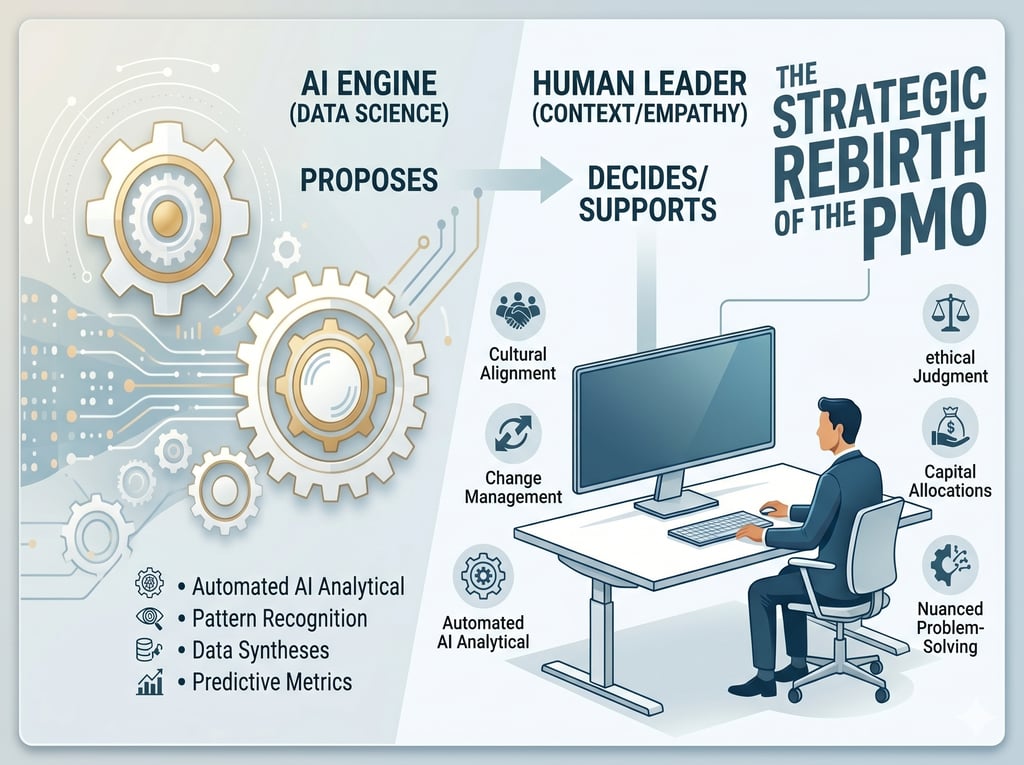
Yet even as AI accelerates analysis, there is a core set of responsibilities it can never own. Despite the analytical velocity of modern algorithms, there remains a vast, fundamentally human domain that AI cannot penetrate. Machine intelligence can synthesize information, but it cannot read the room and ask the hard questions that no one else wants to ask. AI can suggest an optimized resource plan, but it cannot spot the corporate politics or cultural resistance that comes with moving a highly specialized team across organizational silos.
Enterprise strategy execution occurs in a fluid, non-linear environment shaped by corporate culture, conflicting human motives, and shifting market dynamics. AI models lack the contextual empathy required to manage stakeholder relationships, build trust, negotiate compromises between competing business units, or provide ethical judgment when facing gray-area dilemmas.
A machine can easily compute which project is underperforming statistically, but it cannot evaluate whether that project’s failure is due to a broken process, a temporary market disruption, or a team suffering from organizational burnout. Connective tissues like influence, cultural alignment, and change management cannot be coded into an "Agent".
This is where the human-led PMO remains irreplaceable: it bridges raw analytical output and real-world strategic execution, translating insights into decisions, decisions into action, and action into sustainable change.
The Paradigm of Human-in-the-Loop PMO Governance
As AI becomes a key component of core operations, future governance, compliance, and visibility frameworks must ensure a human remains in the loop. The goal is not, and must not be, an autonomous PMO that runs on autopilot; it is a human-guided ecosystem where AI complements the PMO rather than replaces it.
In this model, algorithms process data to surface predictive insights, generate simulations, and play out scenarios (e.g., "If we delay Project A by three weeks to fund Project B, the downstream impact on resource capacity across the portfolio will look like option X, Y, or Z"). Human PMO leaders then step in to validate that analysis against dynamic, subjective factors such as organizational context, non-quantifiable risks, and resource dynamics to make the final call.
This approach also ensures that accountability stays firmly with humans. It mitigates the risks associated with data bias, hallucinated outputs, and overly generic algorithmic recommendations. For executive stakeholders, this balanced governance structure provides confidence that capital allocations and strategic pivots are backed by rigorous data science, yet tailored by an experienced human perspective. AI can propose; only humans can decide.
Elevating the PMO: From Reporting Factory to Strategic Partner
In an AI-augmented environment, the PMO faces a clear choice: remain a reporting factory or become a strategic partner. When a PMO is relieved of tedious administrative work, its evolutionary trajectory accelerates. It transforms from an operational cost center frequently criticized for enforcing rigid templates and chasing late RAID logs into a value-driven strategy hub that directly advises the C-suite.
With administrative tasks handled by AI, PMO professionals can allocate their time to asking higher-value, structural questions that directly influence organizational performance:
Strategic Alignment: Are this year’s initiatives aligned with our long-term strategy?
Value Optimization: Are the benefits we promised still realistic, measurable, and being tracked?
Portfolio Agility: How quickly can we reallocate capital and resources when priorities change?
This evolution completely repositions the department. It ceases to be viewed as a policing mechanism for process compliance and becomes a strategic partner that actively protects investments, optimizes delivery velocity, and guarantees that execution mirrors corporate intent.
Conclusion: Securing the Future of Project Excellence
The rise of AI is not a death knell for the PMO; it marks the end of its administrative era. While machines will inevitably assume the burden of report formatting, timeline calculation, and routine variance tracking, they cannot replicate the strategic vision, leadership, and human judgment that define a mature PMO.
The PMOs that fail in the coming years will not be destroyed by AI itself, but rather by their own resistance to change, remaining anchored to manual reporting metrics until they are redundant. Conversely, the PMOs that thrive will look back at this technological shift as the catalyst that unlocked their true potential. By deploying AI to handle data mechanics, these forward-thinking offices will double down on the human strengths that matter most, securing their place as indispensable, strategic partners at the highest levels of enterprise governance.
AI will not eradicate the PMO; it will elevate the PMOs that are willing to evolve.
How Is Your PMO Evolving?
Is your project management office still operating as an administrative reporting factory, or are you actively transitioning into a data-driven strategy hub? Contact ScaleUp Collective today to learn how we help enterprise teams build modern, AI-augmented PMO governance frameworks that drive measurable value.